10 CBC-Aligned Activities You Can Do With Your Child at Home This Weekend
The CBC is not just what happens at school between 7am and 4pm. It is a philosophy of learning that is designed to extend into everyday life — including weekends at home. Every one of the activities below costs next to nothing, requires no special equipment, and directly builds the competencies Kenya's curriculum is trying to develop.
One of the most common complaints parents have about the CBC is that it generates a lot of project work that feels burdensome — trips to buy art materials, elaborate science kits, printed worksheets. This is a misreading of the curriculum. The CBC's strength lies in its insistence that learning happens everywhere, from your kitchen to your compound.
Each activity below is mapped to one or more of the seven CBC core competencies, so you can see exactly what your child is developing — and why it matters for their school performance and their life beyond it.
The 7 Core Competencies at a Glance
Each activity in this guide is tagged to these competencies:
The 10 Activities
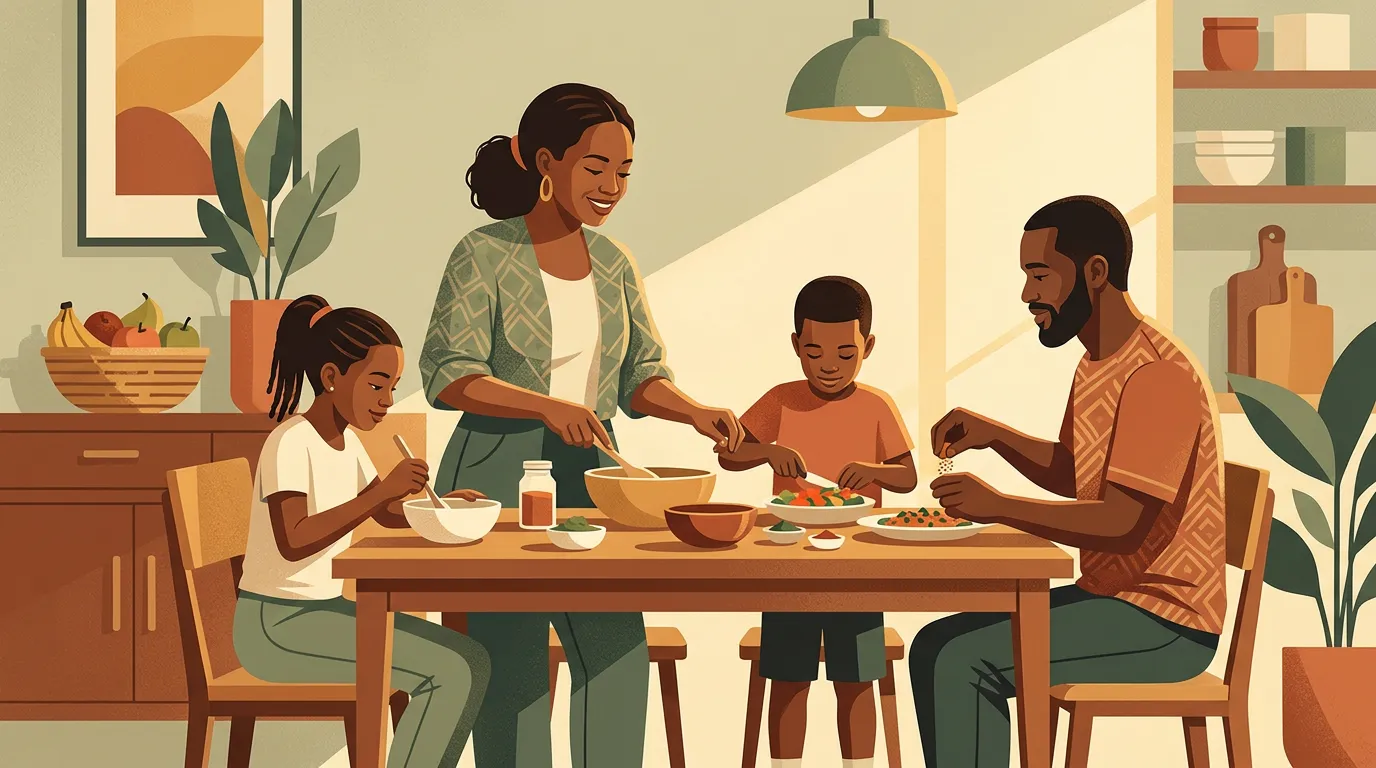
Cook a Meal Together
Cooking is a mathematics and science lesson in disguise. Halving a recipe builds fractions. Measuring flour and water introduces ratios. Watching water boil and dough rise opens doors to basic chemistry. The sequence of steps — prep, cook, serve — builds logical thinking and procedure-following skills that transfer directly to science and maths classwork.
Try this:
Ask your child to double or halve the recipe amounts. Have them estimate how long each step will take before you start. Let them lead — even if it takes longer and gets messy.
Tell a Story — Then Swap
Oral storytelling is one of the most powerful language development tools available — and it is entirely free. Sit together and take turns telling a story: you start with one sentence, your child adds the next, and so on. This builds narrative sequencing, vocabulary, listening skills, and confidence in speaking — all assessed in CBC's Language Activities strand.
Try this:
Use a story starter like: "One morning, a young girl in Kisumu found a strange golden seed in the market..." Take turns adding one sentence at a time. End by asking your child: "What do you think the story means?" That metacognitive step is core CBC practice.
Go on a Nature Walk and Identify Three Things
CBC Environmental Activities at lower primary and Integrated Science at upper primary are built on observation and inquiry. A walk around the neighbourhood or a local park becomes a science lesson when you make it purposeful. Ask your child to find three things they have never looked at closely before and describe them: colour, texture, smell, and why they think it exists where it does.
Try this:
Bring a small notebook. Ask them to sketch one finding and write three observations about it. Do not give them the answers — ask "why do you think so?" and sit with the uncertainty together. That is scientific inquiry.
Run a Mini Family Budget Meeting
Give your child a simple, real scenario: "We have KES 2,000 for groceries. Here is what we need to buy. How should we spend it?" Let them plan, prioritise, and calculate — then take them shopping to see how their plan compares to reality. This builds numeracy, decision-making, and financial literacy simultaneously.
Try this:
After the shop, review together: "What did we have to change? Why? What would you do differently next time?" That reflection step is explicitly required in CBC project-based learning.
Interview a Family Elder
Social Studies and CRE in the CBC place heavy emphasis on community, culture, and oral history. Ask your child to prepare three questions and interview a grandparent, uncle, or neighbour about their childhood, their work, or a significant event in Kenyan history they witnessed. The child takes notes and later summarises what they learned.
Try this:
Help them write the questions first — this is itself a language lesson. After the interview, ask: "What surprised you? What do you want to know more about?" This models the curiosity CBC wants to institutionalise.
Build Something From Recycled Materials
Collect cardboard boxes, plastic bottles, bottle tops, and rubber bands. Give your child a challenge: "Build something useful for the home." A pencil holder, a small shelf, a plant pot. Creative Arts and Design in the CBC value the design process — planning, building, testing, and improving — not just the finished product.
Try this:
Ask them to draw the design first before building. When something does not work, resist the urge to fix it for them. "What do you think is going wrong? What could you try?" builds persistence — the Self-Efficacy competency in action.
Teach a Younger Sibling Something
The single best way to consolidate learning is to teach it. Ask your child to teach a younger sibling — or even you — one concept they learned at school this week. When they explain it, they will discover which parts they truly understand and which parts are still fuzzy. This is called the Feynman technique, and it is exactly what CBC collaborative learning is designed to create.
Try this:
Play the "confused student." Ask questions like "But why does that happen?" or "I don't understand that part." Their effort to explain more clearly is where the deepest learning happens. Be patient and curious, not corrective.
Write a Letter to Someone Who Helped Them
Letter writing is explicitly taught in CBC English. But beyond the grammar, the practice of reflecting on gratitude and expressing it in writing builds emotional intelligence and social awareness — core to the Citizenship competency. Ask your child to write a letter to someone who helped them recently: a teacher, a neighbour, a relative.
Try this:
Postal mail it if you can. The act of sending a physical letter — addressing the envelope, putting it in a postbox — makes it real and memorable. The recipient's reaction, if they respond, is a learning event in itself.
Plant Something and Track Its Growth
A bean seed in a plastic cup of soil costs virtually nothing and teaches biology, data collection, and long-term observation — all in one activity. Have your child plant a seed, set up a simple daily journal (date, height in cm, observations), and make predictions: "How tall will it be by next Sunday?" Checking predictions against reality is the basis of scientific method.
Try this:
Plant two cups — one in sunlight, one in shade — and compare growth. This introduces the concept of variables and controlled experiments, which appears in upper primary and JSS science.
Reflect on the Week Together
On Sunday evening, sit with your child for 10 minutes and ask three questions: What was the best thing that happened this week at school? What was the hardest? What is one thing you want to do differently next week? This structured reflection — called metacognition — is one of the most researched learning strategies in education, and it is central to CBC's Learning to Learn competency.
Try this:
Share your own answers too. When a child sees a parent reflecting honestly on their own challenges and growth, it models that this kind of thinking is for adults as well — not just school homework.
The Best CBC Learning Happens in the Ordinary Moments
None of these activities requires a tutor, a special class, or a significant financial investment. They require time, attention, and the willingness to engage with your child as a curious, capable person who is actively building their understanding of the world.
That is precisely what the CBC is asking of Kenyan homes. The curriculum was designed with the understanding that no school, no matter how good, can do in six hours what an engaged family can do across an entire weekend. Your home is the most powerful learning environment your child has. Use it intentionally — and enjoy the process.
Pick one activity from this list for this weekend. Just one. Do it well, be present, and pay attention to how your child responds. You will be surprised by what you learn about them — and what they learn because of you.