
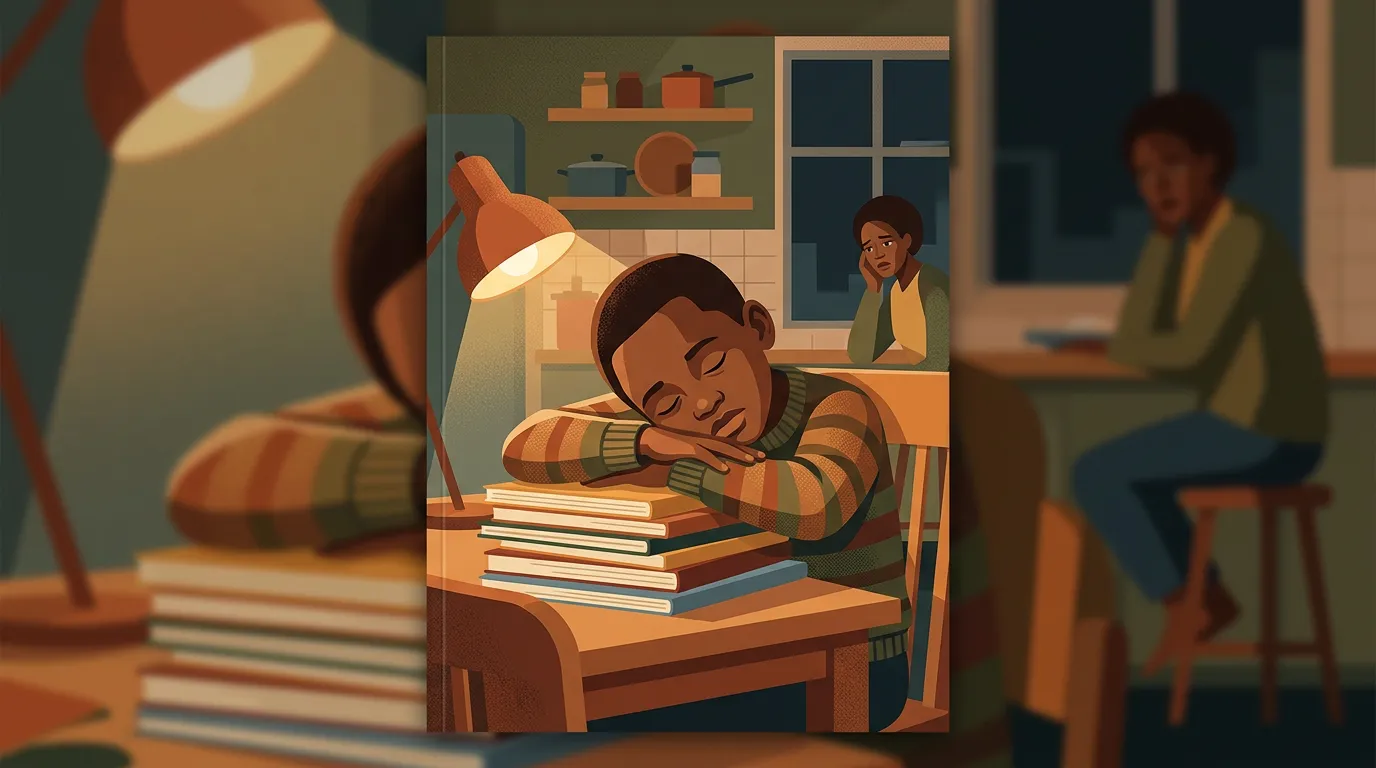
CBC Homework Is Destroying Family Time — And It's Not the Curriculum's Fault
Every evening across Kenya, millions of families sit through the same ritual: a tired child, a stack of exercise books, tears, arguments, and a bedtime that keeps slipping later. Parents blame CBC. But CBC does not mandate this homework. Schools do — and they do it because parents like you keep asking for it.
Let us be precise about something before we go further. The Kenya Institute of Curriculum Development does not prescribe homework amounts. The CBC curriculum framework does not include a nightly worksheet requirement. The homework your Grade 2 child brings home every evening — the mathematics drill, the English exercises, the Kiswahili copy work, the environmental activities colouring page — that is a school policy decision. Often, it is a parent-pressure-driven school policy decision.
The CBC is taking the blame for a problem it did not create, while the actual problem — a school culture still calibrated to an exam-obsessed system that no longer exists — continues unchallenged. This matters, because blaming the wrong thing means you will never fix it.
What the CBC Actually Says About Homework
The CBC's philosophy on learning outside school is clear and consistent throughout the curriculum framework. Here is what it actually prescribes — and what it does not.
What CBC recommends
- Family conversations about what was learned at school
- Reading for pleasure in any language
- Project-based activities connected to real-life contexts
- Community observation and inquiry (nature walks, market visits)
- Portfolio additions from home experiences
- Rest, play, and unstructured exploration
What CBC does NOT mandate
- Nightly written exercises in every subject
- Homework for lower primary children (Grades 1–3)
- Parents marking or completing exercises for children
- Timed drills or rote memorisation tasks
- Homework that takes more than 20–30 minutes at primary level
- Weekend homework packages
The research agrees with the curriculum
Decades of global research on homework in primary schools is remarkably consistent: for children under 10, homework has no measurable positive effect on academic outcomes. For children aged 10–14, effects are small and only appear when homework is moderate, purposeful, and completed independently. The massive homework volumes many Kenyan primary schools assign are not supported by the curriculum or by the evidence. They are supported by tradition and parent expectation.
Who Is Actually Responsible — Schools, Parents, or Both?
Blame here runs in a loop that is hard to break. Schools assign excessive homework because parents expect it. Parents expect it because schools have always assigned it. Schools interpret parent silence as approval. And the child sits at the kitchen table until 9pm, exhausted, while the adults in the system congratulate themselves on their rigour.
Schools are afraid of looking "easy"
In a competitive private school market, a school that reduces homework risks parents interpreting it as a decline in standards. "School X gives so much work — they must be more serious" is a real sentiment that school principals hear and respond to. So homework persists as a signal of seriousness, regardless of its educational value.
Parents are afraid their child will fall behind
Even parents who privately resent the homework load rarely complain to the school, because they fear their child will be disadvantaged if they do. "What if the other children do the work and mine doesn't?" is a paralysing thought. So they supervise the homework, help complete it, and say nothing to the school. The system interprets this as endorsement.
The child pays the price for adult anxieties
A Grade 3 child who does two hours of homework every evening has less time to play, rest, read for pleasure, have family conversations, and engage in the exploratory, self-directed activities that the CBC actually values. They arrive at school the next day tired. They are less curious, less creative, and less emotionally regulated — all things that directly affect their CBC assessment performance. The homework is producing the opposite of its intended effect.
The Real Cost of Homework Overload on CBC Performance
CBC assesses seven core competencies. Here is how excessive homework actively undermines five of them.
| CBC Competency | How homework overload damages it |
|---|---|
| Imagination & Creativity | A child who spends every free moment completing structured exercises never develops the unstructured creative thinking that this competency requires. Creativity needs idle time. Homework eliminates it. |
| Learning to Learn | This competency is about curiosity, self-direction, and intrinsic motivation. Children who associate learning with compulsory, monitored, nightly labour develop the opposite — learned helplessness and resistance. |
| Self-Efficacy | A child who regularly fails to complete homework, or who completes it only with heavy parental help, builds a self-image as a struggling learner. Self-efficacy requires experiences of genuine, independent success. |
| Communication & Collaboration | Homework is typically solitary. Family conversations, storytelling, debates, and collaborative projects build this competency. If homework replaces that family time, the competency goes undeveloped. |
| Citizenship | This competency is built through community engagement, family conversations about current events, and real-world participation. A child doing homework until bedtime engages with none of these. |
How to Push Back — Without Your Child Being Penalised
You have more power here than you think. Schools respond to organised, informed, respectful parent pressure. Here is how to use it.
- Raise it at the parent association level, not individually. An individual parent complaining about homework risks being seen as a problem parent. Ten parents raising the same concern at a parent association meeting forces the school to engage with it as a policy issue. Find your numbers before you raise the issue.
- Frame it around CBC alignment, not personal preference. "Our family prefers less homework" is easy to dismiss. "KICD guidelines and the CBC curriculum framework do not recommend this homework volume for lower primary — can you share the pedagogical rationale?" is a professional question that requires a professional answer.
- Set a family homework limit and hold it. Decide: your child does 20 minutes of homework maximum at Grade 1–3, 30 minutes at Grade 4–6. When the time is up, they stop. Write a note in the book: "We stopped at the 20-minute mark in line with healthy learning practice." Do this consistently for one term and then request a meeting with the teacher to discuss your child's progress. You will find it has not suffered.
- Replace homework time with CBC-aligned family activities. When you set a homework limit, fill that recovered time with activities that genuinely build CBC competencies — reading aloud together, cooking, storytelling, nature observation, family discussions. Your child's portfolio will benefit more from these 30 minutes than from another worksheet.
Stop Blaming CBC for a Problem Schools Created
The CBC is not responsible for your child's exhausting evenings. It is, in fact, trying to prevent them. The curriculum your child is assessed on values curiosity, creativity, collaboration, and self-direction — none of which are built by completing exercise 5B for the fourth time this week.
The schools and the parent culture that insist on heavy homework are not serving the curriculum. They are fighting it — and making your family pay for that fight with your evenings, your relationships, and your child's wellbeing.
The next time you sit down to supervise two hours of primary school homework, remember: the curriculum did not ask for this. You can ask for something different.