How CBC Works in Kenya: A Complete Guide for Parents and Teachers
Kenya's shift from the old 8-4-4 system to the Competency-Based Curriculum (CBC) is the most significant education reform in a generation. Yet many parents and teachers still have questions about what it really means — and what it means for their child. This guide breaks it all down.
The CBC is not just a new syllabus — it is a fundamentally different philosophy of education. Instead of measuring how much a child can memorise and recite in an exam, CBC measures what a child can do with what they know. It asks: can this learner apply their understanding in real life? Can they solve a problem, collaborate with others, think critically, and adapt?
Introduced progressively from 2017, the CBC now governs all learning from Pre-Primary 1 (PP1) through to Junior Secondary School (Grade 9), with Senior Secondary following. Here is everything you need to know.
What Is the Competency-Based Curriculum?
The Competency-Based Curriculum is a learning framework developed by the Kenya Institute of Curriculum Development (KICD) in partnership with the Ministry of Education. It replaced the 8-4-4 system — eight years of primary school, four years of secondary school, and four years of university — with a more flexible, learner-centred pathway.
The name "competency-based" refers to the core idea: education should produce learners who are competent — skilled, capable, and ready for the demands of modern life and work — not merely learners who have passed exams. This distinction is critical. A child who can recite the water cycle but cannot explain why their local river floods after rain has knowledge without competency. CBC aims to close that gap.
Learner-Centred
The learner is an active participant, not a passive recipient. Teachers guide and facilitate; learners explore, question, and create.
Values-Driven
The CBC embeds core values — patriotism, social justice, integrity, and respect — across every subject, not as separate lessons but as daily practice.
Outcome-Focused
Every topic has clearly defined learning outcomes. Teachers know exactly what a child should be able to do, not just recite, by the end of each unit.
The CBC Structure: Grade by Grade
The CBC pathway is structured as 2-6-3-3: two years of pre-primary, six years of lower and upper primary, three years of junior secondary, and three years of senior secondary school.
| Level | Grades | Ages (approx.) | Focus |
|---|---|---|---|
| Pre-Primary | PP1 – PP2 | 4 – 5 years | Play-based; language, numeracy, creativity, social skills |
| Lower Primary | Grade 1 – 3 | 6 – 8 years | Literacy, numeracy, discovery learning in mother tongue |
| Upper Primary | Grade 4 – 6 | 9 – 11 years | Broader subjects; project-based learning; talent nurturing |
| Junior Secondary | Grade 7 – 9 | 12 – 14 years | Deep subject integration; career pathways begin; STEM emphasis |
| Senior Secondary | Grade 10 – 12 | 15 – 17 years | Pathway specialisation: STEM, Arts, TVET, Social Sciences |
A key structural difference from 8-4-4 is the introduction of Junior Secondary School (JSS) — Grades 7 to 9 — which is hosted in secondary schools but uses a curriculum still grounded in the broad, exploratory approach of primary education. Learners at JSS are not yet required to specialise; that comes later, in Senior Secondary.
The Seven Core Competencies
At the heart of the CBC are seven core competencies that every learner is expected to develop across all subjects and at all levels. These are not subjects — they are qualities of mind and character that cut across every learning area.
Communication and Collaboration
Expressing ideas clearly in Kiswahili, English, and mother tongue; working effectively in teams; listening actively and empathetically.
Critical Thinking and Problem Solving
Analysing situations, questioning assumptions, generating creative solutions, and evaluating outcomes with evidence.
Imagination and Creativity
Generating original ideas, expressing oneself through art and innovation, seeing problems as design challenges rather than obstacles.
Citizenship
Understanding rights and responsibilities, respecting diversity, engaging actively and ethically in community life and democratic processes.
Digital Literacy
Using digital tools responsibly and productively; understanding data, online safety, and the role of technology in modern society.
Learning to Learn
Developing curiosity, persistence, and self-regulation; understanding how one learns best and taking ownership of that process.
Self-Efficacy
Believing in one's own ability to succeed; setting goals, managing emotions, bouncing back from failure, and developing a growth mindset that persists through challenges.
How Assessment Works Under CBC
Perhaps the most misunderstood aspect of the CBC is assessment. Many parents still expect end-of-term exams and a ranked class list — the familiar markers of the 8-4-4 era. The CBC takes a fundamentally different approach: continuous, portfolio-based assessment that tracks growth over time rather than measuring performance at a single point.
Formative Assessment (Ongoing)
Teachers assess learners daily through observation, class participation, project work, group activities, and short exercises. This is not graded in the traditional sense — it informs how the teacher adjusts their teaching and how the learner understands their progress.
Summative Assessment (End of Level)
At key transition points — end of Grade 3, Grade 6, and Grade 9 — the Kenya National Examinations Council (KNEC) conducts national assessments. These are not purely recall-based; they include practical tasks and projects that test applied competencies.
Learner Portfolio
Each learner maintains a portfolio — a collection of their best work, projects, reflections, and evidence of competency development across subjects and over time. Portfolios are reviewed by teachers and parents, making learning visible and transparent.
For parents: what this means at home
Your child will bring home projects, crafts, science models, and written work — not just a report card. Engage with this work. Ask what they made, why they made it, and what they learned. That conversation is itself part of the learning.
CBC vs 8-4-4: Key Differences
| Dimension | 8-4-4 (Old) | CBC (New) |
|---|---|---|
| Goal | Pass exams | Develop competencies |
| Assessment | End-of-term exams + KCPE/KCSE | Continuous + national assessments at Grade 3, 6, 9 |
| Teaching style | Teacher-centred lecture | Learner-centred facilitation |
| Language of instruction | English from Grade 1 | Mother tongue in lower primary (Grades 1–3) |
| Pathway | Fixed: 8 primary → 4 secondary → 4 university | Flexible: 2-6-3-3; TVET pathways recognised |
| Values in curriculum | Implicit / peripheral | Explicitly embedded in every subject |
How Parents Can Support CBC at Home
The CBC explicitly recognises parents as partners in a child's education, not spectators. The curriculum expects parental involvement that goes beyond signing a report card. Here is what that looks like in practice.
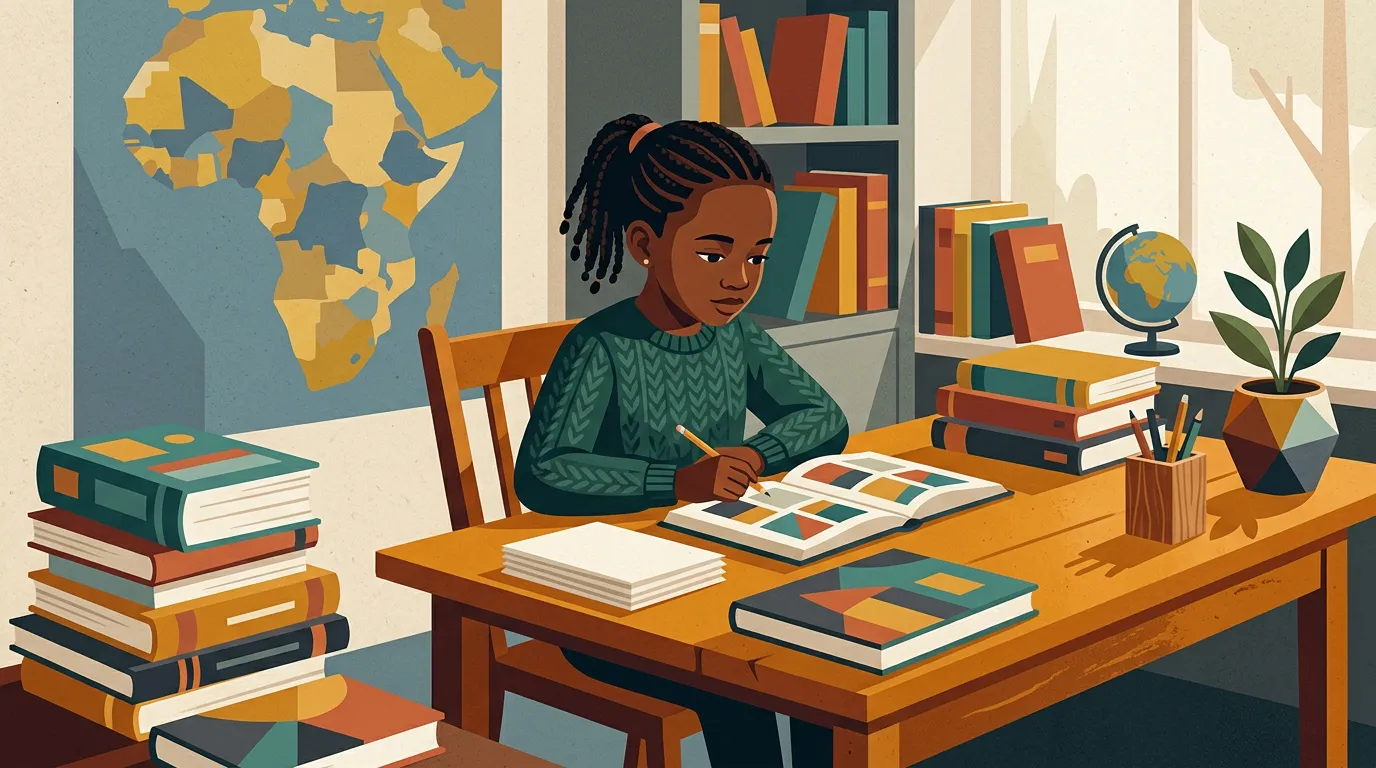
- Create a dedicated learning space. A consistent, quiet, well-lit area for homework and projects sends a clear message: learning matters at home, not just at school.
- Ask about projects, not just marks. "What did you make this week?" is a more useful question than "What grade did you get?" Under CBC, the work itself is the evidence of learning.
- Engage with the mother tongue. In Grades 1–3, instruction begins in the mother tongue. Speaking your language at home actively supports your child's cognitive development during this critical period.
- Review the portfolio together. Ask your child to walk you through their portfolio. Celebrate the effort, not just the result. That builds the self-efficacy competency directly.
- Use digital learning tools deliberately. Platforms like Kusoma align CBC lessons with interactive games, quizzes, and animations that reinforce exactly what your child is learning at school — in a format they genuinely enjoy.
- Stay in contact with the teacher. CBC teachers are trained to assess holistically and share detailed feedback. Use open days and parent-teacher meetings to understand what your child is working on — and where they are thriving or struggling.
Common Concerns — Addressed Honestly
"My child is not being prepared for national exams."
National assessments still exist under CBC — they simply test differently. The Grade 6 assessment (formerly KCPE equivalent) and the Junior School Assessment (Grade 9) are the primary transition milestones. They test applied knowledge, not rote recall.
"Teachers don't understand CBC themselves."
This is a legitimate concern during the transition period. The Ministry of Education has rolled out extensive in-service training, but implementation quality varies by school and region. If you feel your school needs support, raise it with the Board of Management — parents have that right and responsibility under the CBC framework.
"CBC favours children from wealthy families who can afford materials."
Project-based learning can be resource-intensive, and this equity concern is real. However, the curriculum explicitly encourages using locally available and low-cost materials. Teachers are trained to design activities that work without expensive supplies. Digital tools that offer offline access — like the Kusoma app — also help bridge this gap.
"I cannot help my child with CBC homework — it is too different."
You do not need to know the answers. CBC homework is designed to be exploratory — it values the process of finding out over arriving at a correct answer quickly. Ask questions. Explore together. Your curiosity models exactly the kind of learning mindset CBC is designed to build.
A Curriculum Built for the Future Kenya Needs
The CBC is ambitious — and that is entirely intentional. Kenya is preparing its learners not for the economy of the 1980s that shaped 8-4-4, but for the economy of the 2040s: digital, interconnected, rapidly changing, and demanding of adaptability, creativity, and genuine competence.
The transition is not without its challenges. Teachers need sustained professional development. Schools need better infrastructure. Parents need clearer communication from the Ministry. These are legitimate concerns, and a well-functioning education system addresses them through continuous refinement.
But the direction of the CBC — towards depth over breadth, towards application over memorisation, towards the whole child rather than just the exam-passing machine — is right. Every learner in Kenya deserves an education that sees them fully: their talents, their curiosity, their culture, and their potential. That is what the CBC, at its best, aims to provide.