Is Your Child Struggling with Kiswahili CBC Lessons? Here's What to Do
Kiswahili is Kenya's national language, a compulsory CBC subject from PP1 through Grade 12, and one of the most consistent sources of academic stress in Kenyan households. If your child is bringing home poor Kiswahili results or dreading Kiswahili lessons, you are far from alone — and the solutions are more practical than you might think.
There is an irony at the heart of Kenya's Kiswahili challenge. This is supposed to be our language — the language of national identity, East African culture, and daily life in markets, matatus, and homes across the country. Yet walk into any school's end-of-term result and you will find Kiswahili consistently among the subjects where the most children are Below or Approaching Expectation.
The reasons are more nuanced than "the child is not trying." Understanding them is the first step to doing something about it. This article will help you diagnose exactly where your child is struggling and give you a concrete action plan — with or without a tutor, and without needing to be a Kiswahili expert yourself.
Why So Many Children Struggle — Even in Kiswahili-Speaking Homes
Before you can fix the problem, you need to understand it. There are four distinct reasons why children struggle with Kiswahili in the CBC, and each requires a different response.
The home language gap
Many families — especially in urban Nairobi and in communities with a strong mother tongue — speak very little Kiswahili at home. Children who hear Kiswahili mainly at school, mainly in formal instruction, never develop the intuitive fluency that comes from casual daily use. They know about Kiswahili but do not yet live in it.
The grammar complexity
Kiswahili has one of the most complex noun class systems in the world — 15 to 18 noun classes, each with its own agreement patterns for verbs, adjectives, and pronouns. A child who does not hear these patterns regularly in context will struggle to apply them correctly under exam conditions, no matter how much rote drilling they do.
The reading-writing disconnect
Many children can speak passable Kiswahili but cannot read or write it fluently. The CBC assesses all four skills — listening, speaking, reading, and writing — and a child who is strong orally but weak on paper will still receive a low assessment level. Reading and writing in Kiswahili require deliberate, structured practice that speaking alone does not provide.
The Sheng interference
In urban Kenya especially, children speak Sheng — the vibrant Swahili-English-ethnolanguage creole — far more than standard Kiswahili. Sheng is a legitimate, expressive language, but its grammar and vocabulary differ significantly from the standardised Kiswahili assessed in school. Children who primarily speak Sheng often make consistent errors in standard Kiswahili that are not carelessness — they are Sheng interference.
Step One: Diagnose Exactly Where Your Child Is Struggling
"Struggling with Kiswahili" is too broad to act on. Before you book a tutor or buy more exercise books, spend 20 minutes diagnosing which specific skill is failing. This changes everything about what you do next.
| Symptom you observe | Likely root cause | Primary intervention |
|---|---|---|
| Cannot read a simple Kiswahili sentence aloud | Decoding / phonics gap | Daily read-aloud practice; syllable drilling |
| Reads aloud but cannot explain what they read | Comprehension / vocabulary gap | Build vocabulary through conversation and stories |
| Speaks fluently but writes incorrectly | Written grammar / Sheng interference | Structured dictation; written sentences daily |
| Struggles with noun class agreements (e.g. mtoto mzuri vs watoto wazuri) | Grammar pattern not internalised | Pattern drilling through games and songs |
| Can answer questions but writes very short compositions | Writing confidence / vocabulary range | Oral composition before written; word bank building |
| Freezes or refuses to speak Kiswahili | Anxiety / fear of making mistakes | Low-stakes speaking games at home; positive reinforcement |
Do this first
Ask your child to read three sentences from their Kiswahili textbook aloud, then ask them to tell you what those sentences mean in their own words. This 5-minute test will immediately tell you whether the issue is decoding (cannot read the words), comprehension (cannot understand what they read), or neither — and the struggle is actually in writing or speaking.
What to Do at Home: A Practical Playbook
You do not need to be a Kiswahili teacher to make a significant difference. These strategies work precisely because they happen at home, in low-pressure environments, with the person your child trusts most.
Create a Kiswahili zone at home
Designate one meal per week as a Kiswahili-only meal. No English, no mother tongue — just Kiswahili, however broken or hesitant. Make it playful and forgiving, not a test. The goal is to give your child a reason to use Kiswahili naturally, not in the shadow of marks. Even 20 minutes a week of this makes a measurable difference over a term.
Read Kiswahili aloud together every day — even for 10 minutes
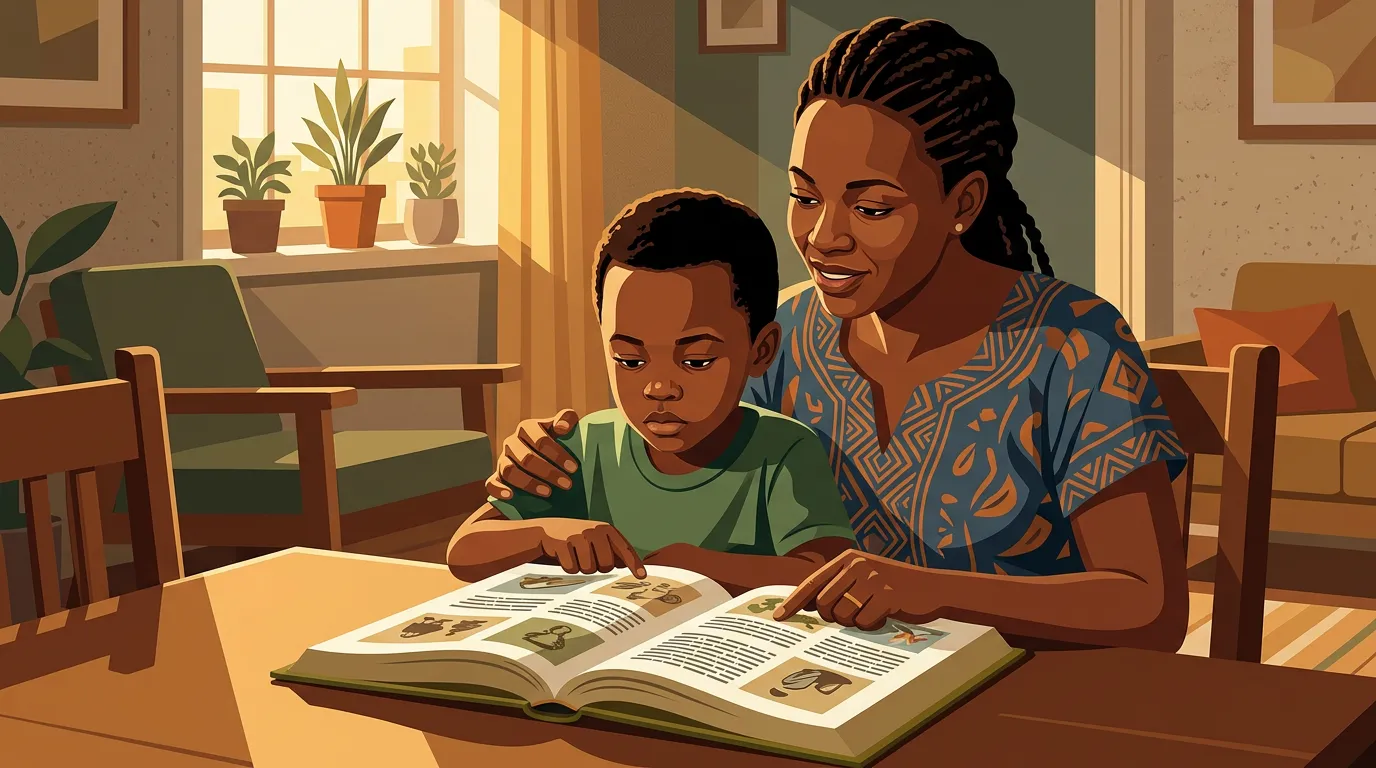
The single most effective Kiswahili intervention is daily oral reading. Use their CBC textbook, a Kiswahili storybook, or a newspaper. Take turns: you read one sentence, they read the next. When they stumble on a word, do not correct immediately — ask them to sound it out syllable by syllable first (Ki-swa-hi-li reads exactly as it sounds; Kiswahili is phonetically consistent, which is an advantage over English). After reading, ask two questions: "What happened?" and "What does [one new word] mean?"
Use Kiswahili music, radio, and TV deliberately
Kenya has rich Kiswahili media. Taarab, bongo flava, Kiswahili news, and Kiswahili children's programmes expose children to standard grammar patterns in a format their brains absorb effortlessly. KBC Kiswahili Service, Kameme FM's Kiswahili programmes, and many YouTube Kiswahili storytellers are free. 30 minutes of Kiswahili audio daily is not a homework task — it is entertainment with a side effect of fluency.
Practise dictation (imla) at home
Kiswahili dictation — imla — is a core CBC assessment tool and one that many children dread because they practise it only in school. Spend 10 minutes twice a week reading 5 to 8 sentences from their textbook while they write. Then check together. Focus not on the score but on the pattern: is the same type of error appearing repeatedly? Repeated errors reveal the specific grammar rule that needs attention.
Build a personal word bank
Get a small notebook — your child's personal Kiswahili dictionary. Every time they encounter a new word, write it down with its meaning and one example sentence. Review 10 words every Friday. This targeted vocabulary building has an immediate, measurable effect on both reading comprehension and composition quality within a single term.
For composition: talk before you write
Children who struggle with Kiswahili insha (composition) usually have ideas but lack the words to write them. The solution is oral rehearsal first. Before your child writes a composition, ask them to tell you the story in Kiswahili — just talk, no paper. You fill in words they do not know. Only after they have told the story confidently do they write it down. This removes the blank-page paralysis and results in significantly longer, more confident writing.
Common Mistakes Parents Make — and What to Do Instead
Hiring a tutor before diagnosing the problem
A tutor who drills grammar with a child whose actual problem is reading anxiety will produce six weeks of frustration and an unchanged assessment level. Always diagnose first (see the table above), then brief a tutor specifically on the identified gap. "My child struggles with noun class agreements but reads and speaks fluently — focus there" is a far more productive tutor brief than "improve their Kiswahili."
Correcting every error immediately
When a child is speaking Kiswahili at home and you interrupt every mistake with a correction, they learn one thing: speaking Kiswahili leads to embarrassment. Research on language acquisition is consistent — error correction during fluency practice damages confidence without improving accuracy. Let them speak. Correct in writing. Model the correct form in your own next sentence without announcing the correction.
Treating Sheng as the enemy
Many parents believe that banning Sheng will improve standard Kiswahili. The evidence does not support this. Sheng is not a corrupted form of Kiswahili — it is a separate, creative language with its own grammar. Suppressing it creates anxiety without improving school Kiswahili. Instead, help your child understand the context-switching skill: "We speak Sheng with friends. We speak standard Kiswahili in school, in formal writing, and when we want to be understood across Kenya." That framing builds code-switching competency — exactly what the CBC is designed to develop.
Buying more exercise books instead of building more exposure
Exercise books test knowledge of grammar rules. But Kiswahili fluency is built through exposure — hearing, reading, and using the language in real contexts. A child who completes 50 exercise book pages but only hears Kiswahili for one lesson a day will improve less than a child who reads one Kiswahili story aloud every night and watches one Kiswahili programme a week. Balance drills with rich input.
What to Focus on by Grade Level
The CBC Kiswahili curriculum has different emphases at each level. Matching your support to the right level prevents the frustration of working on the wrong thing.
| Grade | CBC Kiswahili focus | Best home support |
|---|---|---|
| PP1 – PP2 | Oral language, songs, listening, early phonics | Sing Kiswahili songs daily; name objects around the house in Kiswahili |
| Grade 1 – 3 | Reading syllables and simple words, oral stories, basic sentences | Daily read-aloud; oral storytelling; word bank notebook |
| Grade 4 – 6 | Grammar (noun classes, tenses, agreement), reading comprehension, short compositions | Dictation twice weekly; oral composition before written; pattern games |
| Grade 7 – 9 | Extended compositions (insha), complex grammar, literary texts, fasihi | Read Kiswahili newspapers / novels; discuss fasihi (set books) at home; formal writing practice |
Grade 7-9 specifically: fasihi is where many students fall behind
At junior secondary level, Kiswahili introduces fasihi — literary texts, poetry (mashairi), and set books (hadithi za fasihi). This is where many otherwise competent Kiswahili speakers suddenly struggle. The vocabulary of literary Kiswahili is significantly more formal and archaic than everyday speech. The best intervention: read the set book together at home, discussing each chapter's events and themes in Kiswahili. You do not need to understand the literary terms — you need to make the text feel less foreign by engaging with it outside of school.
When Home Support Is Not Enough — And What to Do Next
Home strategies work for most children within one to two terms if applied consistently. But there are situations where professional support is warranted — and recognising them early prevents compounding delays.
- Two full terms of Below Expectation in Kiswahili despite consistent home support. If you have genuinely implemented daily reading, weekly dictation, and regular conversation practice for two terms and the assessment level has not moved, this warrants a learning assessment. Some children have specific reading difficulties (dyslexia-spectrum challenges) that affect Kiswahili differently than English — and are often missed because Kiswahili's phonetic consistency can mask decoding difficulties.
- Refusal to speak Kiswahili at all — even at home. Extreme avoidance is often anxiety-driven, not ability-driven. A child who physically cannot produce Kiswahili sentences in any context may benefit from a few sessions with a school counsellor before academic intervention. Address the anxiety first; the skills will follow.
- Significant gap between oral and written performance. A child who speaks Kiswahili fluently but cannot write a grammatical sentence may have a processing or motor issue affecting the writing modality specifically. A teacher can help differentiate whether this is a language problem or a writing problem — they have very different solutions.
When seeking a Kiswahili tutor, ask specifically: "What is your approach for a child who [specific diagnosed gap]?" A tutor who responds with "we'll do lots of exercises" without engaging with your specific diagnosis is less likely to be effective than one who describes a targeted approach. Pay for two sessions, assess whether the specific gap is improving, and decide from there.
Kiswahili Is Not the Enemy — Inconsistency Is
Almost every child who struggles with Kiswahili in school can improve significantly with consistent home support over a single term. The language is not innately difficult — it is phonetically regular, it has a logical grammar structure, and it is alive in Kenya's culture, music, and streets. The barrier is almost always exposure: too little of it, too infrequently, and too often in contexts that feel like pressure rather than pleasure.
Your goal as a parent is not to teach Kiswahili grammar. It is to create an environment where Kiswahili is heard, spoken, read, and enjoyed often enough that the language becomes familiar — and familiar things stop being scary. A child who is not afraid of Kiswahili will engage with it in school in a fundamentally different way from one who dreads it.
Start this week with one thing: find a Kiswahili story, news segment, or song you both enjoy, and experience it together. That is the smallest possible step — and it is the right one.